

The most dangerous assumption a director can make is that a clean technical report equals a safe organisation. In an era where ASIC and APRA are increasingly focused on individual accountability, relying on vague assurances is no longer a viable strategy. You know your fiduciary duty requires more than passive oversight, yet the information asymmetry between the boardroom and the server room remains a critical vulnerability. Asking what is it audit processes actually verify shouldn't result in a technical lecture; it must provide a clear picture of your organisation's strategic safety.
This guide will show you how to transform a technical IT audit from a routine checkbox exercise into a powerful governance tool for board-level risk management. We will examine the implications of the ITAF 5th edition released on 26 February 2026 and the NIST CSF 2.0 framework. You will gain the clarity needed to ask the right questions in board meetings. This ensures your oversight is defensible, strategic, and aligned with the professional standards of the AICD and the Australian Computer Society.
Key Takeaways
- Define what is it audit protocols must cover to bridge the gap between technical metrics and your fiduciary duty under Australian law.
- Shift your perspective from hardware-centric reviews to a comprehensive oversight of the entire digital ecosystem, focusing on data and identity.
- Distinguish between the minimum floor of technical compliance and the strategic ceiling of defensible readiness required to satisfy ASIC and APRA scrutiny.
- Equip yourself with the specific questions needed to cut through jargon and expose material risks before they escalate into board-level liability.
- Learn how to transition from a periodic audit cycle to a continuous governance model that aligns with AICD and ACS professional standards.
What is an IT Audit? Defining Digital Governance in 2026
An Information technology audit is the independent examination of an organisation's technology infrastructure, policies, and operations. To understand what is it audit processes truly represent for a director, you must look past the technical jargon. It isn't a mere health check. That term implies a temporary state of wellness that might fade by the next board meeting. Instead, think of it as a structural integrity test for your firm. It validates that your digital assets are managed according to both Australian law and board-level strategy. It serves as the vital bridge between technical complexity and your personal fiduciary accountability.
The Core Purpose: Beyond the Technical Checklist
The audit establishes a baseline of truth that's entirely independent of internal IT reporting. It identifies the critical gap between stated policy and actual operational reality. This is vital for maintaining a defensible position in the event of a breach or regulatory inquiry from ASIC or APRA. Under the 5th edition of the IT Audit Framework (ITAF) released on 26 February 2026, this oversight now explicitly includes AI governance and digital trust. It ensures that the systems you rely on for decision-making are as resilient as the law requires.
IT Audit vs. Financial Audit: The Critical Difference
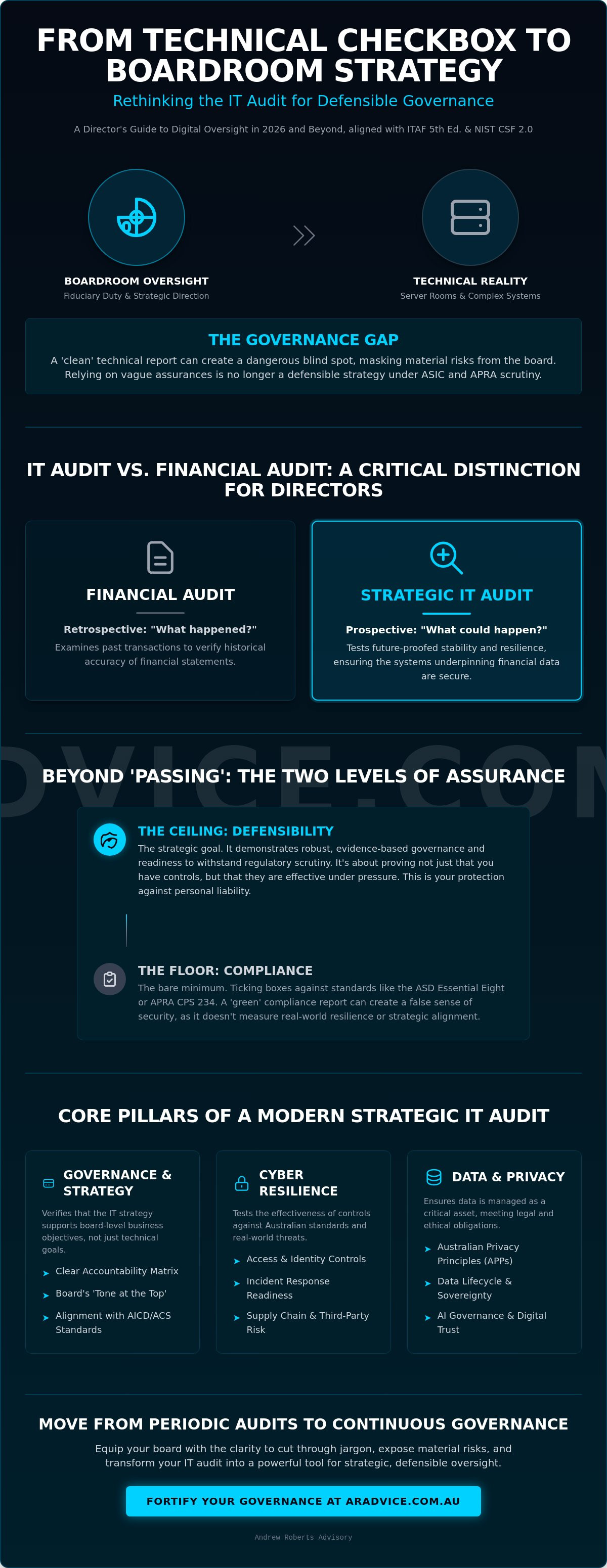
Financial audits typically look at what happened in the past to ensure the books are accurate. IT audits look at what could happen in the future. Technology risk now underpins every line on your balance sheet. Relying solely on your financial auditor's review of IT general controls is a dangerous oversight. Those reviews are often too narrow for true governance. A strategic audit ensures resilience by confirming that the systems generating your financial data are actually secure. It moves the conversation from historical accuracy to future-proofed stability.
The Anatomy of a Modern IT Audit: Scope and Standards
A modern audit encompasses the entire digital ecosystem. We've moved beyond hardware-centric reviews to data and identity-centric oversight. Understanding what is it audit frameworks now require means looking at how information flows across cloud boundaries and third-party networks. It's no longer enough to secure the perimeter; you must secure the data itself. For directors, this shift is critical. Your liability doesn't stop at your office walls. It extends to every vendor and AI model your organisation touches.
Governance and Strategic Alignment
Strategic alignment is the foundation of digital governance. An audit must evaluate if the IT strategy actually supports the board's business objectives. We look for a clear accountability matrix. When a system fails, who owns the risk? The 'tone at the top' regarding security and ethics is equally vital. If the board doesn't prioritise digital resilience, the rest of the organisation won't either. For directors seeking to fortify their oversight, validating this alignment is the first step toward a defensible position.
Security Controls and Cyber Resilience
Resilience is measured against Australian standards like the ASD Essential Eight and APRA CPS 234. These aren't just technical suggestions; they're the benchmarks for regulatory scrutiny. A robust audit tests the effectiveness of access controls and identity management. It reviews incident response readiness. We don't just look at the plan; we look at the ability to execute it under pressure. This includes analysing third-party and supply chain risks that could bypass your internal defences.
Data Integrity and Privacy Compliance
Compliance with the Australian Privacy Principles (APPs) is a non-negotiable fiduciary duty. Audits must verify data lifecycle management. Are you keeping data you no longer need? This creates unnecessary liability. We also examine the sovereignty of data in cloud environments to ensure it meets Australian legal requirements. With AI governance now a critical frontier, ensuring your data's integrity is essential for both ethical operations and legal safety.
Compliance vs. Defensibility: Why 'Passing' Isn't Enough
A 'green' audit report is often a director's most dangerous blind spot. It creates a false sense of security that masks systemic governance failures. When you ask what is it audit outcomes actually signify, the answer should never be a simple 'pass.' Compliance is merely the minimum floor. Defensibility is the ceiling directors must aim for to satisfy the high standards of the AICD. Many boards fall into the trap of 'audit theatre,' where impressive metrics hide unmitigated risks. An ISO 27001 certification doesn't mean you're safe; it means you've documented a process. It's a badge, not a shield.
The Limitations of Checkbox Audits
Technical teams can inadvertently 'game' an audit by focusing on the specific scope of a checklist rather than the fluid reality of the threat landscape. These point-in-time assessments are static. They fail to account for the rapid escalation of AI-driven risks seen in early 2026. A clean report won't prevent a regulatory settlement if ASIC determines your oversight was passive or lacked intellectual rigour. In the Australian context, the gap between compliance and safety is where legal liability lives. If a breach occurs, the 'we passed our audit' defence rarely holds up if the underlying controls were known to be weak. You cannot delegate your fiduciary duty to a third-party certificate.
Establishing Defensible Oversight
Establishing defensible oversight means moving from 'trusting the report' to 'verifying the mechanism' of control. This requires independent advisory to interpret technical data through the lens of governance and Australian law. Audit findings should inform your fiduciary decisions and strategic risk appetite, not just your IT budget. By interrogating the audit process, you ensure your organisation is ready for the scrutiny of the law. This shift in perspective transforms the audit from a technical burden into a strategic asset that protects both the firm's reputation and your personal liability as a director.
The Director’s Question: Navigating the Audit Report
Directors don't need to be coders. You must, however, be expert interrogators of the audit process. Technical teams often present reports filled with dense jargon that obscures material risk. Your role is to cut through this noise to find the vulnerabilities that threaten your firm's reputation. When reviewing what is it audit documentation provides, look for red flags. Vague phrases like "satisfactory progress" or "minor deviations" often signal a lack of transparency. If a report lacks specific dates or clear ownership, it isn't a governance tool; it's a liability.
Interrogating the Findings
The strength of your oversight is defined by the questions you ask. Start with these three punchy inquiries during your next board meeting to expose hidden gaps:
- "What was the most significant risk you didn't look at?" Every audit has a scope. Knowing what was excluded is often more important than knowing what was included.
- "If this control failed today, how long would it take us to realise?" This tests operational resilience rather than theoretical compliance. It moves the conversation from "if" to "when."
- "How does this finding impact our legal obligations under the Privacy Act?" With the April 2026 regulatory landscape prioritising data sovereignty, this question connects technical failure to direct legal exposure.
Driving Accountability
Remediation must match the severity of the risk. Management responses in the audit should be actionable, not just aspirational. Avoid accepting "ongoing" as a status. Demand specific timelines for every high-risk finding. Link these outcomes directly to executive KPIs and your broader digital strategy. This ensures that audit insights lead to concrete improvements in your security posture rather than sitting in a digital drawer. To ensure your board has the tools to drive this level of change, you can request a 48-hour readiness review to validate your current oversight mechanisms and close the accountability gap.
Beyond the Audit: Moving to Strategic Readiness
An audit is the beginning of the strategic conversation. It is not the conclusion of the board's duty. Understanding what is it audit data reveals is only valuable if it translates into a defensible accountability matrix. Andrew Roberts Advisory turns technical insights into board-ready governance frameworks. We bridge the gap between what IT reports and what you actually need to know to meet your fiduciary obligations. This moves your organisation from a state of reactive compliance to one of strategic readiness.
Facilitating Board-Level Simulations
A static audit cannot test your response to a live crisis. We use specific audit findings to facilitate high-stakes incident simulations. These exercises test the human element of governance. They move you from theoretical risk on a page to practical crisis leadership. This is where your Cyber Governance Readiness Review becomes a tangible asset. It ensures the board can lead with composure when an escalation occurs. You stop relying on technical teams to manage the firm's reputation and start leading the response.
The Role of Independent Advisory
You need an advisor with no conflicts of interest to interpret audit data. Our independence is your greatest safeguard. We don't sell software or managed services; we provide pure governance oversight. This establishes a permanent culture of defensible readiness rather than a cycle of annual panic. By moving faster than the traditional audit cycle, our 48-hour review process delivers high-impact results that respect the pace of executive decision-making. This alignment with AICD and ACS professional standards ensures your oversight survives regulatory scrutiny. Secure your board's legacy by ensuring your governance is as rigorous as the law requires.
Fortifying Your Board's Defensible Position
A clean audit report in 2026 is no longer a shield against regulatory scrutiny; it's a starting point. Your fiduciary duty under the Corporations Act 2001 requires you to look beyond technical metrics and verify the structural integrity of your organisation's digital governance. Understanding what is it audit frameworks verify allows you to move from passive acceptance to active, defensible oversight. By interrogating findings and demanding actionable remediation timelines, you transform a technical exercise into a powerful strategic asset that protects both the firm's reputation and your personal liability.
True resilience requires an independent perspective free from vendor conflicts. Andrew Roberts Advisory provides the board-level expertise needed to interpret complex data and ensure your oversight meets the rigorous standards of the AICD and ACS. Don't wait for a breach to discover the gaps in your reporting. You can Book a Cyber Governance Readiness Review with Andrew Roberts Advisory to secure a clear, unbiased assessment of your current risks. With a structured approach to governance, you can lead your organisation with confidence and meet every regulatory challenge from a position of strength.
Frequently Asked Questions
Is an IT audit the same as a penetration test?
No, a penetration test is a narrow technical simulation of an attack, while an IT audit is a comprehensive governance review. Pen tests identify specific exploitable vulnerabilities at a point in time. An IT audit examines the broader framework of controls, policies, and strategic alignment that ensures long-term organisational resilience.
How often should an Australian board commission an IT audit?
Australian boards should commission an audit at least annually to maintain a defensible position. For organisations governed by APRA CPS 234, reviews must occur more frequently if there is a material change to the technology environment. Regularity ensures your oversight remains relevant against the evolving threat vectors identified in early 2026.
Can our internal IT team conduct their own IT audit?
No, internal teams cannot audit their own work if the goal is to provide the board with independent assurance. Independence is the cornerstone of a valid what is it audit process. Using an external advisor removes internal bias and ensures the board receives an unvarnished baseline of truth that survives regulatory scrutiny.
What are the legal consequences for directors if an IT audit is ignored?
Directors face significant personal exposure under Section 180 of the Corporations Act 2001 for failing to exercise due care and diligence. Ignoring audit findings can lead to ASIC enforcement actions or disqualification. Recent Federal Court rulings have established that cyber risk management is a core fiduciary duty, not a technical option.
What is the difference between an IT audit and a cyber security audit?
An IT audit focuses on the entire technology lifecycle, including operational efficiency and strategic alignment with business goals. A cyber security audit is a specialised subset that focuses exclusively on the protection of assets from digital threats. Both are essential components of a robust board-level risk management framework.
How much does a comprehensive IT audit typically cost for an AU firm?
Costs vary based on organisational complexity and the depth of the digital ecosystem. While I won't estimate specific fees here, industry benchmarks from 2025 indicate that mid-market Australian firms typically invest between $30,000 and $85,000 for a thorough external review. This is a strategic investment compared to the multi-million dollar costs of a data breach.
What is the 'Essential Eight' and should it be part of our audit?
The Essential Eight is a set of prioritised mitigation strategies developed by the Australian Signals Directorate (ASD). It must be a core component of your audit. These strategies provide a proven baseline for cyber resilience that Australian regulatory bodies, including APRA and the OAIC, consider the industry standard for protection.
What happens if our IT audit reveals a significant breach?
You must immediately trigger your incident response plan and assess your obligations under the Notifiable Data Breaches (NDB) scheme. If the breach is likely to result in serious harm to individuals, you have a legal requirement to notify the OAIC within 30 days. Transparent reporting is critical for maintaining your legal standing and board-level integrity.