

In 2026, the most valuable technology consultant is not the one who builds the system; they are the one who ensures the board can defend its oversight of it. You likely feel the pressure of information asymmetry as technical teams report operational success while the Corporations Amendment (Digital Assets Framework) Bill 2025, which received Royal Assent on 8 April 2026, demands a new level of accountability. It's a common anxiety for directors who are tired of "checkbox" compliance that fails to translate technical jargon into genuine business risk.
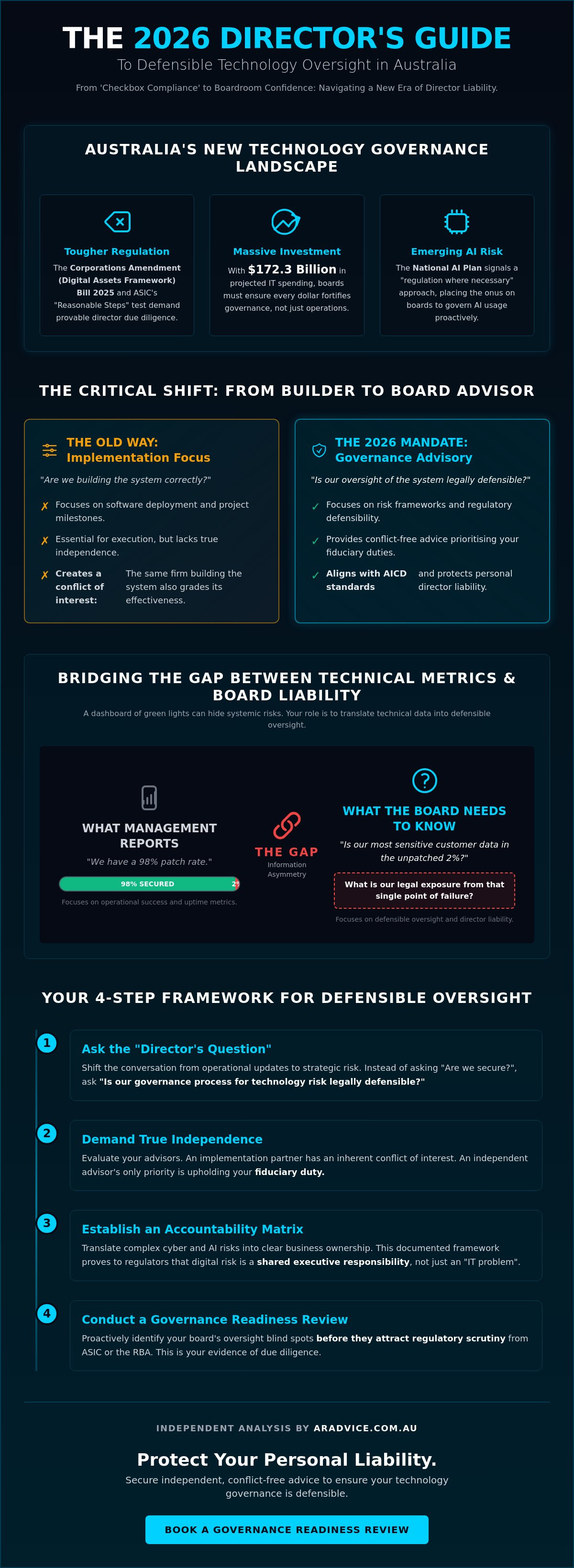
This guide provides an independent framework to bridge that divide and protect your personal liability. You'll gain the clarity needed to transform opaque IT metrics into a defensible oversight strategy that aligns with Australian Institute of Company Directors (AICD) standards. We'll examine the shift from implementation to strategic governance, the impact of the National AI Plan, and how to verify that your portion of the projected $172.3 billion in Australian IT spending for 2026 actually fortifies your organisation against ASIC scrutiny.
Key Takeaways
- Understand why the role of a technology consultant in 2026 has shifted from technical implementation to providing independent, board-level strategic advisory.
- Bridge the gap between operational IT metrics and defensible governance by learning to ask the "Director’s Question" during high-stakes board briefings.
- Compare the Big 4 consulting model against independent specialists to secure conflict-free advice that prioritises your fiduciary duties over vendor sales.
- Establish a structured accountability matrix that translates complex AI and cyber risks into the language of business resilience and regulatory compliance.
- Discover how to conduct a Governance Readiness Review to identify oversight blind spots before they attract scrutiny from ASIC or the RBA.
Redefining the Technology Consultant for the Australian Boardroom
The traditional view of a technology consultant as a back-room technician is obsolete. In 2026, boardrooms require strategic advisors who translate technical complexity into the language of fiduciary duty. With Australian IT spending projected to exceed $172.3 billion this year, directors can't afford to delegate technology oversight to technical teams alone. You need a bridge. This role exists to close the literacy gap between the CISO’s technical metrics and the board’s legal accountability. It's about moving from "What are we building?" to "What are we risking?"
Implementation vs. Advisory: Knowing the Difference
Implementation consultants focus on software deployment and meeting project milestones. They're essential for execution, but they often lack the independence to critique the very systems they build. Advisory consultants focus on risk frameworks and defensibility. Boards frequently hire implementation firms when they actually need governance advisory. This mistake creates a conflict of interest where the person grading the homework also wrote it. True advisory requires a "governance-first" mindset that aligns with Australian Computer Society (ACS) professional standards.
The 2026 Regulatory Landscape in Australia
The regulatory environment has sharpened significantly. The Corporations Amendment (Digital Assets Framework) Bill 2025, which received Royal Assent on 8 April 2026, signals a definitive shift in director accountability. ASIC now applies a rigorous "Reasonable Steps" test to technology oversight, particularly regarding AI and data resilience. Directors must prove they've exercised due diligence, not just signed off on a capital expenditure request. Technology is no longer a cost centre; it's a core component of your legal responsibility under the Corporations Act 2001 (Cth). A modern technology consultant ensures your oversight is not just active, but legally defensible.
Technical Metrics vs. Defensible Governance: The Critical Gap
A dashboard full of green lights is often the most dangerous thing in the boardroom. It creates a false sense of security while systemic governance risks remain hidden in plain sight. Management reporting typically focuses on operational uptime or patch rates, but these metrics rarely inform strategic risk. As a director, your primary concern isn't the technical minutiae. It's whether your oversight can withstand regulatory scrutiny. You need to pivot from asking "Are we secure?" to "Is our oversight defensible?"
This is where the distinction in what technology consultants do becomes critical for the board. While internal teams manage the tech, an independent technology consultant stress-tests the narrative. They identify the hidden gap between technical success and board-level liability. This is especially vital given the National AI Plan released on 2 December 2025, which adopts a "regulation where necessary" approach. If your board hasn't verified management's claims through an independent lens, you're operating on trust rather than evidence.
What IT Reports vs. What the Board Needs to Know
IT reports often fail to translate technical vulnerabilities into business-critical liability. A 98% patch rate sounds successful until you realise the remaining 2% includes your most sensitive customer data. A strategic advisor reframes these data points into a narrative of risk that aligns with your corporate strategy. They ensure that reports don't just provide data, but provide the context required for informed decision-making. If you're unsure if your current reporting meets this standard, a governance readiness review can expose existing blind spots.
Establishing an Accountability Matrix
Defensible governance requires clear ownership across the executive team. An accountability matrix ensures that digital risk isn't just "an IT problem" but a shared responsibility. It defines who is accountable for data resilience and ensures escalation paths are tested before a crisis occurs. Defensible oversight is a documented, rigorous framework of inquiry and verification that proves a director has fulfilled their fiduciary duty to mitigate technology-related risks under the Corporations Act 2001 (Cth).
Evaluating Technology Consulting Models: Who Should You Hire?
Selecting a technology consultant is a strategic decision that directly impacts your personal liability. The Big 4 offer scale and implementation-heavy frameworks. These are useful for massive deployments, but their business models often rely on high-volume junior staff and proprietary software sales. Boutique implementation firms provide deep technical expertise for specific platforms, such as the digital wallets now regulated under the Treasury Laws Amendment (Payments System Modernisation) Act 2025 (Cth). However, specialised technical skill is not the same as governance expertise. A board-level technology consultant must prioritise your fiduciary duty over project milestones.
The Conflict of Interest Trap
Firms that sell software or manage implementation budgets cannot provide an unbiased governance review. It's an inherent conflict. Pure advisory firms explicitly distance themselves from vendor partnerships to establish a foundation of trust. Before signing a retainer, ask: "Does your firm receive commissions or referral fees from the vendors you recommend?" If the answer is anything but a clear "no," your oversight isn't independent. You need a partner who has no stake in the size of your IT budget or the software you select.
Key Criteria for Board-Level Advisors
A board-level advisor must demonstrate mastery of Australian corporate governance, not just IT. They should align with the 5th Edition of the ASX Corporate Governance Principles, effective since 1 July 2025. Look for consultants who conduct high-stakes simulations that test your 48-hour readiness for a cyber escalation. They must translate technical vulnerabilities into the language of the Corporations Act 2001 (Cth). This ensures every director understands their specific legal and ethical accountability. Does your advisor fortify your resilience or just sell you more tools?
Implementing a Governance-First Digital Strategy
Governance is not a byproduct of technical implementation. It is the foundation. To meet the expectations of the 5th Edition of the ASX Corporate Governance Principles, boards must move beyond passive acceptance of IT reports. A technology consultant facilitates this by shifting the focus from project milestones to defensible oversight. This process begins with a Governance Readiness Review. This diagnostic identifies oversight blind spots that management teams often overlook. It ensures your digital strategy aligns with the firm’s risk appetite and specific legal obligations under the Corporations Act 2001 (Cth).
The next phase involves establishing reporting cadences that prioritises defensibility. You don't need more data; you need better evidence of due diligence. This means translating technical performance into business resilience metrics. Every report should answer the "Director’s Question" regarding legal and ethical accountability. If your current reporting doesn't allow you to justify your oversight to ASIC, it's failing. You can schedule a 48-hour readiness review to verify your current governance standing.
Cyber and AI Governance: The New Frontiers
AI implementation creates a "black box" risk in corporate strategy. The National AI Plan, released on 2 December 2025, requires boards to govern AI through existing, technology-neutral laws. This means you are responsible for the outcomes of AI decision-making. An independent technology consultant ensures your AI governance framework meets these emerging Australian standards. They help integrate cyber resilience into the core business continuity plan, ensuring technology is treated as a fiduciary duty rather than a technical hurdle.
Facilitated Incident Simulations
Paper-based exercises fail to prepare boards for real-world breaches. They lack the pressure and complexity of a live escalation. Facilitated incident simulations test your board's decision-making under duress. These high-pressure scenarios expose weaknesses in your communication protocols and accountability matrix. The consultant captures these "lessons learned" to fortify your governance structures. This creates a documented trail of readiness that is essential for meeting regulatory scrutiny during a post-incident review.
The Independent Advisor: Establishing Accountability and Oversight
Trust in the boardroom is built on transparency and the absence of hidden agendas. Andrew Roberts Advisory operates as a bridge between technical complexity and director liability. Unlike implementation-heavy firms, an independent technology consultant focuses exclusively on your fiduciary duty. We provide the sober realism required to meet the "Reasonable Steps" test applied by ASIC. Our 48-hour readiness review delivers rapid, high-impact insights that respect the pace of executive decision-making. We move your board from a state of reactive compliance to one of defensible confidence.
No Conflicts of Interest: Our Manifesto
Pure advisory requires a total separation from the technical implementation budget. We don't sell software, hardware, or managed services. This independence ensures our reporting is unbiased and focused solely on your oversight needs. We explicitly distance ourselves from vendor conflicts to establish a foundation of trust. By avoiding the conflict of interest trap discussed earlier, we ensure that our findings serve the board, not a sales quota. Our commitment is to provide clear reporting that translates tech metrics into business risk, aligned with Australian Computer Society (ACS) professional standards.
Next Steps for Australian Directors
Initiating a strategic review doesn't require disrupting your daily operations. It starts with identifying the hidden gaps in your current management reporting. Prepare for your next board meeting with data that is legally and ethically defensible under the Corporations Act 2001 (Cth). Ensure your oversight framework is ready for the scrutiny of the 5th Edition of the ASX Corporate Governance Principles. You can Book a Governance Readiness Review with Andrew Roberts to fortify your organisation’s resilience and protect your personal liability.
Fortifying Your Boardroom for the 2027 Regulatory Horizon
The distinction between technical success and defensible governance is the difference between a secure organisation and an exposed director. You've seen how green dashboards can mask systemic vulnerabilities. True oversight requires an independent lens, free from the conflict of interest inherent in implementation-heavy firms. As the Corporations Amendment (Digital Assets Framework) Bill 2025 approaches its April 2027 commencement, the window for establishing robust, board-level accountability is closing. It's no longer enough to trust management's technical metrics; you must verify them through a lens of fiduciary duty.
Choosing an independent technology consultant who specialises in Australian director duties ensures your oversight is both rigorous and legally sound. Our advisory is conflict-free and aligned with the high standards of the AICD and ACS. We don't sell tools. We build resilience. You can meet the rising expectations of ASIC and the RBA with a structured, defensible framework that transforms anxiety into strategic calm. Take the first step toward a more secure future today.
Secure your board's legacy with a Cyber Governance Readiness Review
Frequently Asked Questions
What is the difference between an IT consultant and a technology consultant for the board?
An IT consultant typically focuses on technical delivery, system architecture, and project milestones. They're implementation-oriented. A board-level technology consultant focuses on strategic risk, fiduciary duty, and defensible oversight. Their role is to translate technical data into the language of governance, ensuring directors can meet regulatory scrutiny without getting lost in technical minutiae.
Does a technology consultant need to be an expert in every software we use?
No, a strategic advisor requires expertise in governance frameworks and risk management rather than specific software functionality. They focus on the accountability matrix and how technology impacts your business resilience. Their value lies in their ability to stress-test management’s claims and ensure your technology strategy aligns with the 5th Edition of the ASX Corporate Governance Principles.
How much does a typical technology consulting engagement cost in Australia?
Senior consultants in Australia command hourly rates between $250 and $400 or more as of April 2026. Specialized contractor day rates for high-stakes roles, such as Cybersecurity Managers, average $1,504, while Data and AI Managers sit at approximately $1,432 per day. These rates reflect the high demand for specialized skills that bridge the gap between technical execution and board-level oversight.
Why should boards hire an independent technology consultant instead of relying on their CISO?
Independence is the cornerstone of trust and provides a necessary check on management bias. While a CISO is responsible for operations, an independent technology consultant provides a conflict-free verification of those operations. This separation is vital for defensible oversight, ensuring the board receives an unbiased view of systemic risks that internal teams might inadvertently minimise or overlook.
What are the legal implications for directors who ignore technology governance advice?
Ignoring expert advice can lead to a breach of director duties under Section 180 of the Corporations Act 2001 (Cth). ASIC applies a "Reasonable Steps" test to determine if a board exercised due diligence. If a technology failure occurs and the board cannot prove they sought and acted upon independent advice, directors face significant personal liability and regulatory penalties.
How often should a board engage a technology consultant for a readiness review?
A formal readiness review should occur at least annually or when significant regulatory changes arise. For instance, the Royal Assent of the Corporations Amendment (Digital Assets Framework) Bill 2025 on 8 April 2026 necessitated immediate reviews for many Australian firms. Regular engagements ensure your governance framework remains resilient against evolving threats and shifting legal obligations.
Can a technology consultant help with AI risk management frameworks?
Yes, they're essential for navigating the "regulation where necessary" approach of the National AI Plan released on 2 December 2025. An advisor ensures your AI governance meets technology-neutral laws and Australian Computer Society (ACS) professional standards. They help boards understand the "black box" risks of AI decision-making and establish clear accountability for automated outcomes.
What should be included in a technology consultant's engagement letter?
The letter must explicitly define the scope of oversight, the independence of the advisor, and the specific regulatory frameworks being addressed. It should include a "No Conflicts of Interest" clause to ensure the advice remains untainted by vendor partnerships. Crucially, it should outline how the consultant will translate technical metrics into the defensible data required for board-level reporting.